Simple musical ideas can help children practise listening, sound play, early words and shared interaction.
Children learn to communicate through countless small, repeated moments; listening, watching, copying, taking turns and slowly connecting words to people, actions and feelings. Music to support speech and language development works because it brings many of these building blocks together in a way that feels playful rather than effortful. Songs carry built-in patterns, rhythm gives timing a shape children can feel, and repetition offers chance after chance to try again without feeling tested.
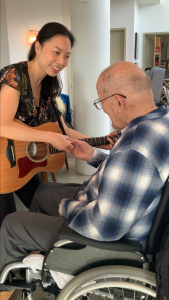
For some children, spoken language unfolds gradually and without much fuss. Others need extra support because of developmental delay, autism, hearing difficulties, attention differences or other communication needs. Music therapy doesn’t replace speech pathology, but research summarised by Australia’s Raising Children Network shows it can help children build skills such as shared attention, social interaction and communication when used alongside other supports. At Musicgrace, children use singing, movement, instruments and musical routines to build confidence at a pace that suits them.
Why Music Supports Speech and Language Development
Music supports early communication because it naturally invites listening and response. When a child hears the same short phrase in a song repeated across a session, they start to recognise sound patterns and anticipate what comes next, useful predictability for children who need extra processing time. When a familiar song pauses, it creates a clear opening for the child to join in with a sound, gesture, word or movement.
Rhythm also helps children organise their attention. Clapping, tapping or moving to a beat gives the body and brain something structured to follow, making it easier to notice syllables, imitate sounds or wait for a turn. Many children are also more willing to copy a sound inside a song than in response to a direct instruction, singing softens the pressure and turns speech practice into something closer to play.
This extends to non-verbal communication too. Pointing to an instrument, choosing a song, waiting for a turn or smiling during a pause are all genuine communication moments. A registered music therapist can shape these into structured goals that support expression, understanding and social connection over time.
How Singing, Rhythm and Repetition Build Early Communication
Singing gives children a clear, memorable way to hear language. Words inside songs are often slower, more repeated and more expressive than everyday speech, which helps children notice individual sounds and practise them without pressure. A therapist might choose songs built around repeated words – go, stop, more, hello, bye, ready, that can then be carried into home routines and broader therapy goals.
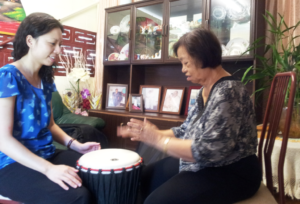
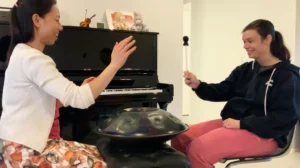
Rhythm supports timing and turn-taking in a similar way. A child might tap a drum after the therapist, shake an instrument during their turn, or stop the moment the music stops. These small exchanges build listening, attention, impulse control and back-and-forth interaction, while repetition gives a child the many practice chances most new skills need before they feel familiar.
Families can bring these ideas home simply: sing the same short song before pack-up time, use a brief rhythm before saying a key word, pause during a favourite line and wait, or copy a child’s own sound and turn it into a playful exchange. Small, repeated moments like these help communication grow without making a child feel pushed.
Bringing These Ideas Home
Home is one of the best places to build communication, because it’s where children use language for real reasons, asking for food, requesting help, choosing toys, greeting family members or responding to daily routines. Bringing music into these everyday moments can make them clearer and more engaging without adding pressure.
A simple morning song can help a child settle into the day. A getting-dressed song can name clothing and body parts. A snack-time song can encourage words like more, finished, open or help. A movement song can support action words such as jump, clap, stop and go. None of this needs to be elaborate, short, repeated and predictable songs tend to work best.
Giving children time matters just as much as the songs themselves. After singing a line or offering a choice, pausing gives a child room to respond in ways adults can easily miss if they move too quickly, a sound, a glance, a reach or a smile can all count as communication. When families notice and respond warmly to these attempts, children learn that what they’re doing matters. Musicgrace can help families choose home strategies that fit their child’s developmental goals and communication style.
Practical Ideas for Families and Therapists
There are several simple, well-tested ways to bring music into communication practice. One is the “fill in the gap” song: sing most of a familiar phrase, then pause just before the final word, leaving space for the child to finish it with a word, sound, gesture or movement. Another is musical choice-making, offering two instruments or two songs and waiting for the child to choose.
Call-and-response songs work in a similar way. An adult sings a short phrase, then waits for the child to respond – beginning with sounds rather than words if that’s where the child is at, and shaping the response toward clearer words over time as appropriate. Movement songs help too, connecting words directly to actions: hearing clap, jump, stop or turn while doing the movement makes language feel concrete.
A registered music therapist can adapt these activities for children with sensory needs, attention differences or limited speech, and families can repeat the same ideas between sessions for more practice in familiar surroundings. The activities that work best are usually the ones that feel natural and easy to repeat.
When Music Therapy May Help
Music therapy may be a useful support when a child enjoys music, responds to rhythm, copies sounds, moves to songs, or seems noticeably more engaged during musical play than during direct speech tasks. It can also help children who find communication frustrating, avoid direct speech practice, need support with attention, or rely on non-verbal ways of expressing themselves. A registered music therapist can use a child’s existing musical interests to build structured activities around their specific communication goals.
Music therapy works well alongside speech pathology, occupational therapy, psychology, education supports and everyday family routines, with each professional focusing on a different part of a child’s development. Within that picture, music therapy can offer a motivating, relationship-based pathway for practising listening, imitation, sound production, turn-taking and social interaction.
At Musicgrace, sessions are shaped around each child’s needs, strengths and support plan. For families accessing NDIS funding, goals may include improved communication, social participation, attention or daily living skills, all while keeping the child engaged and genuinely enjoying the process. If you’d like to talk through whether music therapy could support your child’s speech and language goals, contact Musicgrace for a no-obligation conversation, or browse our music therapy FAQs for more detail on what sessions involve.